
by Eleanor Greene, outreach and communications coordinator
Mike Oliver believes in his community, and always has. His first paid job was in the first community-based facility in California for youth with developmental and physical disabilities, in the 1970s, a time when people with disabilities were being moved out of institutionalization and into different types of care.
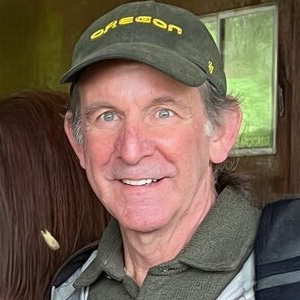
“I had a little fire in my belly—I was pretty appalled when I was going into the institutions that a society like ours could have such horrible conditions for people that were members of our own society,” Mike says. “I felt this need to try to do something about that.”
In fact, Mike spent his career trying to figure out housing and care for people with different types of disabilities who had been passed around by or left behind by government agencies and care systems. He worked in non-profits to develop housing and care that would work better for their clients. Later, he founded a consulting firm that worked with a hospital system on regulations and human rights related to the hospital’s long term care facilities.
From Hospital Beds to Garden Beds
Trying to better the world he lived in didn’t stop after work hours. Despite the fact that he was almost always on-call in his work roles, he found peace in his home in Southwest Portland and a cabin off the grid in southern Washington. In both places, he worked with his wife to restore the landscape, learning about and planting native plants and restoring the health of waterways. On their Portland property, the Olivers were the partial recipients of an Oregon Watershedwatershed an area of land that channels rainfall, snowmelt, and runoff into a common body of water, such as a nearby lake or river. Multiple streams can be part of the same watershed area, such as the Tryon Creek Watershed which is fed by Oak Creek, Park Creek, Falling Creek, and others. Enhancement Board (OWEB) grant, to help restore the tributary of Arnold Creek, which feeds into Tryon Creek. With that support, and a lot of their effort, their property has received platinum status from the Backyard Habitat Certification Program, a program supported by West Multnomah SWCD funding.
During this restoration work, which began over 20 years ago, Mike would trade stories with a nurse who worked for him, who was also an avid gardener and board member of East Multnomah SWCD. Her stories stuck with him after his retirement, and he had interacted with the District as a longtime volunteer for our program Stormwater Stars.
In 2023, Mike applied to be on West Multnomah SWCD’s budget committee, where he learned more about the District and put his organizational budget skills to work. Then, he decided to run for an open position on the board, to which he was elected in November 2024, and was since voted by the board to be Treasurer. Since then, he’s been actively involved in the hiring committee for two staff positions, in addition to his regular Treasurer duties.
Always Inspired by People-Power
“I think it is increasingly important that people recognize all government is local and that there’s a lot that people can do, at various levels, to move their neighborhoods, their cities, their regions, forward,” Mike says. “At a time where we’re battling climate change and everything else, the whole business of attending to conservation and thinking hard about how we’re going to use water or land or other natural resources is becoming more and more important.”
Mike sees so many ways to join in with community to build stronger local landscapes, encouraging people to make connections to volunteer with local boards, or on task or project levels with conservation partners. Since his first job, Mike has had a strong belief in the communities he’s been a part of.
“Communities don’t exist without people volunteering to take part. Building and strengthening communities has always been a very important aspect to me. And this is one way that I can do it now in retirement,” Mike says. “So, I’m enjoying it and really thoroughly enjoying the people I’m meeting along the way.”